
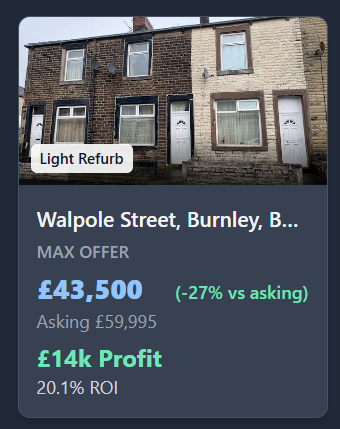
If you overpay, it doesn’t matter how good the area is.
The difference between a strong deal and a weak one is often just 5–10% on the purchase price. Serious investors don’t “make an offer and hope.” They calculate their maximum offer first.
In this guide, we’ll break down exactly how to calculate your maximum offer on a property investment in the UK — step by step.
Your maximum offer is the highest price you can pay for a property while still hitting your target returns.
That might mean:
If the numbers don’t work at that price, you walk away.
That discipline is what protects capital.
Before you calculate anything else, you need a realistic end value.
For a buy-to-let or BRR deal, this means:
Avoid the common mistake of relying purely on estate agent optimism. Always sense-check with recent sold comparables.
Example:
Estimated end value (after refurb): £120,000
Many investors underestimate costs. That’s where deals quietly fall apart.
Your total costs should include:
Example:
Refurb: £15,000
Purchase costs: £4,000
Finance & holding costs: £6,000
Total additional costs: £25,000
Now determine what makes the deal worth doing.
For example:
This is strategy-dependent. Your maximum offer should reflect your model — not emotion.
A simplified maximum offer formula looks like this:
Maximum Offer = End Value – Total Costs – Required Profit
Using the example:
End value: £120,000
Total costs: £25,000
Required profit/equity buffer: £15,000
Maximum Offer = £120,000 – £25,000 – £15,000
Maximum Offer = £80,000
That’s your ceiling.
If the property is listed at £95,000, you already know it doesn’t fit — unless your assumptions change.
Even experienced investors slip up. The most common errors include:
The more manual your process, the easier it is to make errors.
Spreadsheets work — until they don’t.
They create:
When you’re analysing multiple deals a week, speed matters. Hesitation costs opportunities.
Serious investors need to know within minutes whether a deal works.
Your maximum offer is not a negotiation tactic. It’s a risk control mechanism.
Calculate it before you speak to the agent.
Stick to it.
And let the numbers make the decision.
If you want instant calculations for ROI, yield, refurb costs and maximum offer in seconds — without juggling spreadsheets — that’s exactly what Property Assistant was built to do.